02:00
Lecture – DISC Assessment & Team Dynamics
ANSCI 4040 – Team Projects & Collaboration
Ass. Prof. Dr. Miel Hostens
Why talk about personality in team projects?
Context
- You are working in teams on a semester‑long project
- Technical skills matter — but how you work together often matters more
- Many team conflicts are not about competence, but about differences in style
Typical team friction (you’ve probably seen this)
- “They never speak up” vs “They talk too much”
- “Too slow and careful” vs “Too impulsive”
- “Too emotional” vs “Too cold and distant”
DISC gives us a neutral language to talk about these differences
2‑minute warm‑up
Pair‑share
In your project group:
What is one behavior that annoys you in team work?
What is one behavior you need from others to do your best work?
The goal is not to judge people — it’s to notice patterns.
What is DISC?
The big idea
DISC is a behavioral framework, not a test of intelligence, values, or ability.
It describes patterns in:
How people communicate
How they approach tasks
How they respond to challenges and others
Important disclaimers
- DISC is not a diagnosis
- There is no good or bad type
- Most people are a blend, not a pure type
- Styles describe preferences, not limits
Two popular ways you’ll see DISC explained
1. Letters (classic DISC)
- D – Dominance
- I – Influence
- S – Steadiness
- C – Conscientiousness
2. Colors (“Surrounded by Idiots”)
Based on the book by Thomas Erikson:
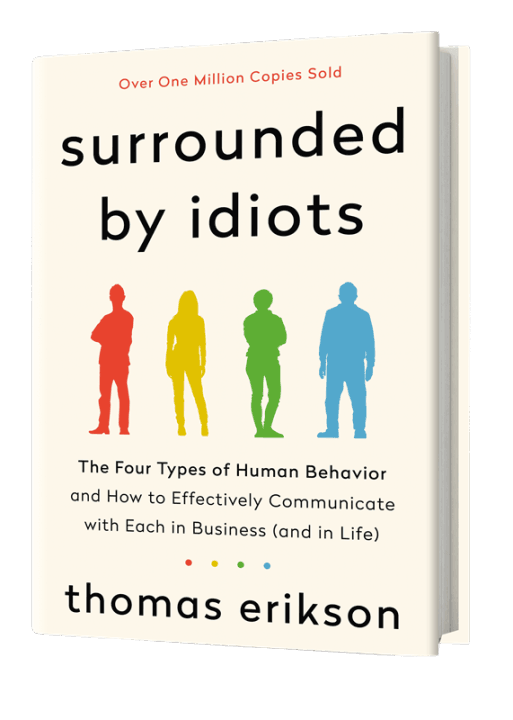
2. Colors (“Surrounded by Idiots”)
Red (D) – Dominant
Yellow (I) – Influential
Green (S) – Steady
Blue (C) – Conscientious
Same underlying ideas — different language
The “map” of DISC
A simple way to visualize
DISC is often described using two rough axes:
- Pace: Fast‑paced vs More measured
- Focus: Task/results vs People/relationships
| Task / Results focus | People / Relationship focus | |
|---|---|---|
| Fast‑paced | Red (D) | Yellow (I) |
| More measured | Blue (C) | Green (S) |
Not perfect science — but a helpful mental model.
The DISC dimensions (letters + colors)
Red (D) – Dominance
Focus: Results, action, winning
Typical behaviors
Direct, fast‑paced, decisive
Comfortable with disagreement
Likes to take charge
Strengths - Gets things moving - Clear decisions - Handles pressure well
Red (D) – Dominance
Potential blind spots
Can seem impatient or blunt
May skip details or others’ input
Often‑cited examples (illustrative, not diagnoses)
Elon Musk (entrepreneurial drive, speed)
Gordon Ramsay (direct, high standards)
Yellow (I) – Influence
Focus: People, ideas, energy
Typical behaviors
Expressive, enthusiastic
Thinks out loud
Enjoys collaboration and recognition
Strengths - Generates ideas - Motivates others - Creates momentum
Yellow (I) – Influence
Potential blind spots
Can lose focus
May over‑promise / under‑deliver
Often‑cited examples
Oprah Winfrey (connection, influence)
Richard Branson (vision, enthusiasm)
Green (S) – Steadiness
Focus: Harmony, stability, trust
Typical behaviors
Patient, calm, supportive
Good listener
Prefers predictable workflows
Strengths - Team glue - Reliability - Conflict de‑escalation
Green (S) – Steadiness
Potential blind spots
Avoids conflict
Resists rapid change
Often‑cited examples
Keanu Reeves (calm, respectful presence)
Fred Rogers (empathy, consistency)
Blue (C) – Conscientiousness
Focus: Accuracy, quality, logic
Typical behaviors
Analytical, structured
Data‑driven
Asks critical questions
Strengths - High‑quality output - Risk reduction - Clear documentation
Blue (C) – Conscientiousness
Potential blind spots
Overthinking
Perfectionism
Often‑cited examples
Bill Gates (systems thinking)
Marie Curie (rigor, precision)
DISC is about preferences, not skills
Key distinction
- DISC = how you prefer to act
- Skills = what you are capable of doing
Examples:
A Green (S) can still lead
A Red (D) can still listen
A Yellow (I) can still analyze
A Blue (C) can still inspire
Awareness creates choice
DISC in student teams
Common team patterns
- Reds (D) push decisions and deadlines
- Yellows (I) generate ideas and energy
- Greens (S) keep the team aligned
- Blues (C) ensure rigor and quality
Teams struggle when:
One style dominates
Differences are interpreted as personal flaws
Example misunderstanding
- Blue (C): “This needs more checking.”
- Red (D) hears: “You’re slowing us down.”
- Red (D): “Let’s just decide.”
- Blue (C) hears: “You don’t care about quality.”
DISC helps translate intent vs impact.
Mini‑activity: “Translate the message”
Scenario
Your teammate writes:
“Can you send me your part by tonight? We’re behind.”
Task
Rewrite that same message in a way that would land best for each style:
Red (D)
Yellow (I)
Green (S)
Blue (C)
Using DISC constructively
Practical rules
- Don’t label people — describe behavior
- Adjust communication, not personality
- Balance speed, people, and quality
Simple adaptations
- Talking to a Red (D) → be concise, outcome‑focused
- Talking to a Yellow (I) → show enthusiasm, brainstorm
- Talking to a Green (S) → be patient, inclusive
- Talking to a Blue (C) → bring structure and data
One‑slide matrix: strengths each style brings
If you have all four styles in a team…
- Red (D): momentum and decisions
- Yellow (I): creativity and energy
- Green (S): trust and follow‑through
- Blue (C): rigor and quality
Strong teams don’t all think alike — they coordinate differences.
DISC under stress
Stress amplifies defaults
When pressure rises, people often overdo their preferred style.
- Red (D) under stress: gets more controlling / impatient
- Helpful response: give options + timelines, stay concise
- Yellow (I) under stress: talks more, becomes scattered
- Helpful response: summarize decisions, assign next steps
Stress amplifies defaults
- Green (S) under stress: withdraws, avoids conflict
- Helpful response: ask directly, create psychological safety
- Blue (C) under stress: over‑checks, delays decisions
- Helpful response: define “good enough,” set a decision point
“Under stress” is not a flaw — it’s a signal.
Team reflection worksheet
Individual reflection
Write short answers (1–2 sentences each):
My likely style(s): ______ (e.g., Green (S) + Blue (C))
I’m at my best in a team when: ______
Under pressure, I tend to overdo: ______
A teammate behavior that triggers me is: ______
One thing I can do this week to adapt better is: ______
Connecting DISC to project roles
Typical fit (not a rule)
- Project manager / decision driver: often Red (D) or Yellow (I)
- Stakeholder liaison / interviewer / presenter: often Yellow (I)
- Operations / scheduling / keeping everyone aligned: often Green (S)
- Data lead / QA / methods & documentation: often Blue (C)
The key message
You can do any role — but knowing your default style helps you:
Choose strategies that work for you
Ask for the support you need
Avoid predictable failure modes
Self‑awareness before team awareness
Why start with yourself?
- You are always part of the system
- Stress amplifies your default style
Reflection questions:
What do I overdo under pressure?
Which style frustrates me most — and why?
What does my team need more of?
Your assignment (before next class)
DISC self‑assessment
- Complete the free DISC assessment: https://professionalleadershipinstitute.com/disc-assessment/
- Download your results PDF
- Share the PDF with me, if you feel comfortable
I will:
- Combine results across the class
Privacy / professionalism
- This is for learning and reflection, not labeling
- If you prefer, you may remove your name from the PDF before sharing
What we’ll do next class
In‑class follow‑up
- Look at class‑level DISC distributions
- Discuss strengths and gaps across teams
- Connect DISC insights to your ongoing project work
The goal is not to change who you are — but to work better together.
Final takeaway
Remember
- Differences are normal
- Awareness reduces friction
- Adaptation improves teams
DISC gives us a shared language — what you do with it is up to you.
https://bovi-analytics.github.io/BeastsAndBytes/